
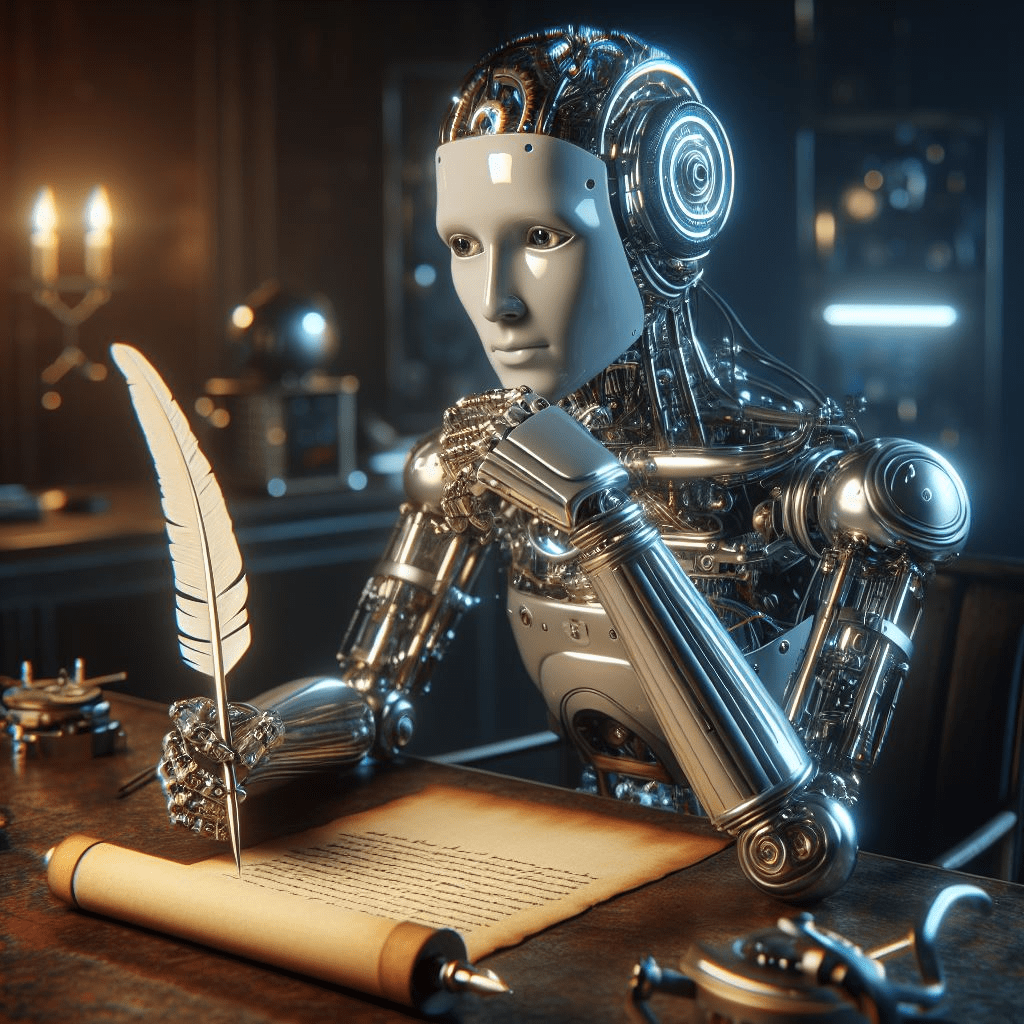
Image Created with CoPilot.
There is no doubt that Artificial Intelligence can be a great tool. It can speed up the writing process and assist with other tasks as well, but I cannot help but wonder if it will change how we think. A comforting thought to consider it that AI technology is based on the design of the human brain, and creates content based on what it finds. Which means that it mirrors us.
In this study, Graduate students were able to use AI to come up with solutions to real world problems. They were shocked that the AI produced very similar results to what they had come up with on their own. Read Article Here.
What happened next was that the graduate students realized that they now had to come up with new and creative ideas. They could not rely on ChatGPT to do this for them.
In this example it seems that the danger of AI is not what it knows, but how much we will rely on it. GenAI reflects our own limits back to us. When we misplace trust in a system that humans created, we may be disappointed to find out that the answers are not there like we want them to be.
Another thing to be aware of in this area is that AI scans content that has already been created, so it is important to be mindful that queries could lead to some inappropriate information. In the digital age everyone gets a voice and can use the internet to try to connect to others. This has always been true for the internet age; AI can bring malicious information to you unknowingly. On a traditional search engine there was some intentionality by the user clicking the link and then choosing to continue onto a website. The AI can provide what seems to be a valid source that contains dangerous information.
If we are going to be interacting with AI, we cannot fall asleep at the wheel. As parents we must teach our children to challenge AI. Using the example of the graduate students in the study, once they became aware of the limits of AI, they were able to understand the faults in their thinking. Then they began to come up with their contributions to the problem. Allowing them to use AI as a tool to spur thinking, not doing the work for you.
In “Saving Expertise, or Critical Editing as Manslaughter-by-AI Prevention Strategy,” Marit MacAruthur sends a warning about how we cannot sit by passively while AI does the tasks that we are responsible for. Using the example of pilots that became complacent because of AI technology that ultimately led to the plane crashing. The pilots relied too heavily on the AI systems, instead of recognizing the dangerous situation they were in. This relates to AI and writing because with so much content available, parents and teachers still need to recognize the potential dangers and pitfalls of AI tools and act responsibly.
Instead of having AI be a constant generating machine, we must explore and what it is able to assist with. We get to be the definers of what AI’s role will be in our thinking and writing.
In AI and Writing Sid Dorbin lays out several ways writers and students can use AI. These include Prewriting, Research, Drafting, Revising, and Proofreading/Editing. There are multiple possibilities of how to use AI in each step. He also points out at every step the choice is up to the writer to determine if what has been generated can be useful and fits with their own voice.
A key point to make with AI is that it is not an infallible tool. It is prone to having “hallucinations.” Which in short are inaccurate facts. When I created a ChatGPT account, it made me acknowledge that it was not always correct. So even when using AI as a research tool, it is important to cross reference information.
Another researcher that has done a lot of work in AI and academics is Troy Hicks, he lays out similar ideas about how to use AI can help students and writers. These suggestions are Research Assistant, Thinking Partner, and Co-Writer. Hicks’s analysis seems to focus on being more precise in questioning AI to get better answers, but like Dorbin the student or writer has to be in control of the messaging.
In a study conducted by Marzuki et al. reported that AI tools have been used by English Foreign Language teachers in Indonesia. The teachers have reported that the AI writing tools have improved their student’s language and writing skills. Using a variety of AI tools the students were able to get instant feedback along with teachers being able to develop individualized learning plans.
The study also identified potential drawbacks to the use of these tools. Primarily over reliance. With over reliance students only make the corrections that have been suggested without learning the how or why of how they have been suggested in the first place. Leading Marzuki et al. to recommend a balanced approach when using AI tools.
When it comes to using AI, the writer is still in the driver’s seat. How much of creative control that the AI will be given is up to them. What makes writing great is that the writer connects with the audience. That is a human connection. Reading Homer’s Odyssey connects the reader to the Ancient Greeks, reading Walden connects you to Thoreau, reading Jane Austen connects you to the Victorian era. A writer can use AI to help generate new ideas, to help hone their work, but will still have the ultimate say if it reflects what he or she is trying to say.
 Artificial Intelligence Size-Up
Leave a comment